It's the End of the Robotics World As We Know It
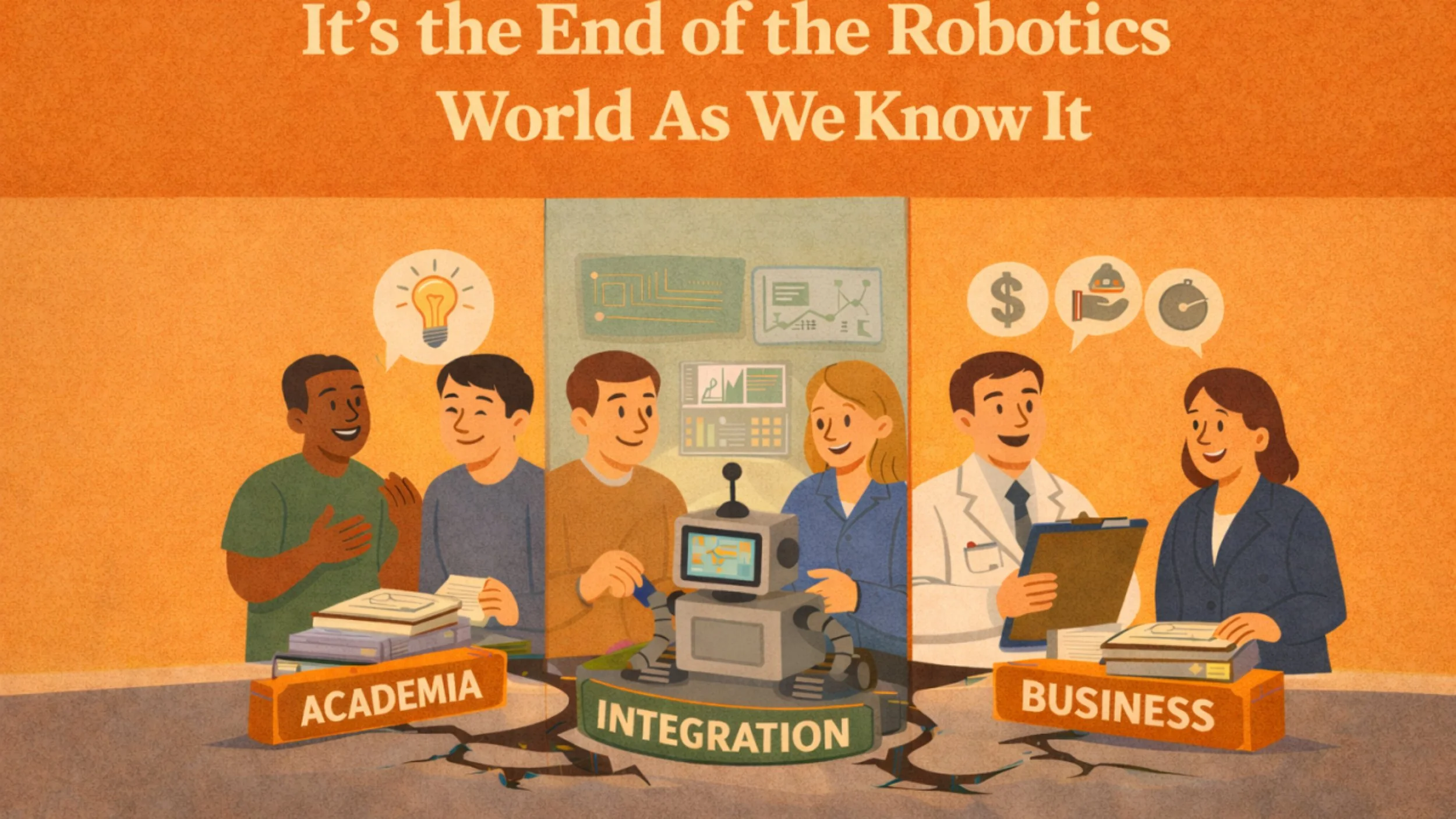
Illustration depicting integrating of academia, integration, and business in healthcare robotics [AI-generated image] (Open AI 2025)
…and I feel fine.
Over the past few months, I visited my first robotics conferences in three very different worlds: the academic world of ideas, the integrators’ world of data and systems, and the business world of value. Each speaks a different language. Each measures success differently. I'm trying to figure out how to learn how to connect across all three worlds.
World 1: Academia, vision without deployment
I visited ICRA2025 for the first time in May where I saw hundreds of robots accomplishing truly amazing feats. There were dazzling prototypes, hundreds of papers, and rooms full of creativity. When I reflected on my experience, I often did not see is a clear path to deployment in a working hospital. When I ask, “Who is this for, and how will it be used in week one,” the answers can be vague. That is not a flaw in research, it is the nature of exploration. But without translation, great ideas stop at the after the presentation’s last question.
My Takeaway: Lead conversations with academic collaborators with “Who is the user, what job is being done, where does it live, how will we measure benefit, and what are the first three risks to de-risk”. Turn inspiration into an initial pathway, then test it quickly and safely on a single ward before scaling.
World 2: Integration, it is all about the data
I visited Foxglove Actuate 2025 (also for the first time), in October. I noticed the conversation shifts to software, data, and infrastructure. People talk about ROS2 architectures, observability, simulation to real transfer, and telemetry that lets robots learn from every edge case. This is where reliability is born, not from a single algorithm but from disciplined pipelines that focus on getting ‘reps’ for your system every day.
My Takeaway: treat robots as data products as much as hardware. Instrument for perception, interaction, safe stops, and environment context from day one. Review signals weekly in “What did we learn” sessions, then iterate like a hospital quality improvement cycle. Finally, attracting talent wherever you are is crucial. Leverage your own area’s hidden advantages instead of pining for the resources of Silicon Valley.
World 3: Business, robots must be valuable
I visited HLTH 2025 (yes, also for the first time) in October. In the commercial world, the question is simple: who pays and why. The booths may be full of AI-driven apps, motors, and actuators, but the talks that matter are about ROI, reliability, and regulation. Many robotics startups do not fail because the technology is impossible. They fail because the value story is not credible for the buyer who carries the risk.
My Takeaway: speak the language of value that clinical and administrative leaders already track. Throughput, staff safety and satisfaction, time freed from nonclinical work, reduced overtime, reliability during peak load, and compliance. Pick one unit, set a conservative target, and let verified results tell the story.
Bridging the three worlds
When research, integration, and business operate as silos, robotics looks like three different futures. The next era belongs to the bridge builders, the teams that cross-pollinate ideas between simulation, deployment, and value creation. These teams do a few things differently:
Translate early. They describe the first week in the real environment, not just the final vision.
Normalize lowercase f failure. Small, safe missteps are the fast feedback loops that prevent capital F failures later. (see previous article)
Add guardrails, then move with courage. Clear stop rules and human override make it possible to iterate safely inside regulated spaces.
A simple playbook we use at Rovex
Data flywheel from day one, so every interaction teaches the system something useful.
Value narrative that the buyer can audit, grounded in their metrics, not ours.
Blameless learning rituals, so issues surface early and trust grows.
Why this matters for healthcare
Hospitals are living systems. Success is not just better sensors or smarter models, it is smoother integration pipelines, safer workflows, better business models, and empathy for the people who use the tools. When the three worlds work together, research inspires builders, builders inform businesses, and businesses fund the next round of research. That is when acceleration happens where it actually counts, at the bedside and in the back corridor where work gets done.
Final reflection as an academic/integrator/CTO hybrid: your job is to be the translator in chief. Connect vision, engineering, and value. Respect small failures because they protect you from large ones. And measure progress by how quickly the system learns without putting patients or staff at risk.'
OpenAI. (2025). Illustration depicting integrating of academia, integration, and business in healthcare robotics [AI-generated image]. DALL·E. http://openai.com/